
The Graduation Dilemma: Social Proof vs Algorithmic Liquidity
Every week, a media buyer on Reddit asks the exact same question: I have a winning ad in my testing campaign—do I duplicate it into my scaling campaign, or do I use the Post ID? You spent $500 testing a new concept. The cost-per-acquisition (CPA) is 30% below your target, and the click-through rate is holding steady. Now you need to move that ad into your primary Advantage+ Shopping Campaign (ASC) to scale spend.
Five years ago, the answer was universally Post ID. You wanted to carry over the likes, comments, and shares because social proof drove conversion rates. Today, the architecture of Meta's delivery system has fundamentally changed. Auction-based delivery models like Advantage+ and the tighter audience controls imposed by modern attribution shifts have killed the old playbook. As noted in recent industry research from NewForm, the traditional method of splitting traffic across two ad sets, waiting, and picking a winner is dead.
Worse, forcing a Post ID into a modern scaling campaign often chokes delivery. Contrarian media buyers, including Muhammad Arsalan, have correctly identified that Post-IDing your ads might actually hurt performance. When you limit placements by forcing a static post, you shrink the available playing field for the algorithm. That means fewer impressions, less audience diversity, and ultimately, a higher CPA. You are trading algorithmic liquidity for a few emojis in the comment section.
To scale efficiently, you need a systematic approach to moving validated creatives out of testing and into scaling without resetting your baseline metrics.
The Asymmetric Graduation Framework
Graduating an ad is not a button click; it is a protocol. We use a three-step system called the Asymmetric Graduation Framework to ensure winners transition smoothly into scaling environments.
Step 1: The Isolation Sandbox
You cannot test new creatives inside your main scaling campaign. Mixing unproven concepts with your core revenue-driving ads forces the algorithm to reallocate budget to learn about the new ad, starving your winners of oxygen.
Separating testing from scaling prevents proven winners from being destabilized every time you introduce unproven creatives.
Your testing environment must be a dedicated campaign, typically using Campaign Budget Optimization (CBO) with strict minimum spend limits on ad sets to force delivery. This isolates the volatility of testing from your baseline revenue.
Step 2: The Parity Validation
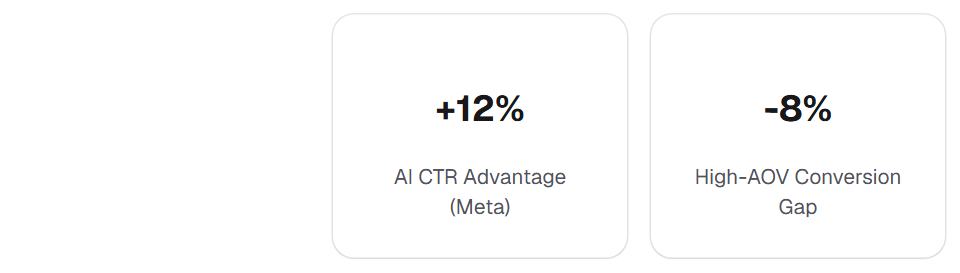
Before an ad graduates, it must prove it can survive at scale. According to benchmarks published by Digital Applied in their 2026 AI ad creative dataset of over 50,000 variations, AI-generated ad creatives achieve a +12% AI CTR Advantage on Meta compared to human-created baselines. Furthermore, the Digital Applied benchmark identifies a strict <$100 ROAS Parity Threshold, establishing that any return on ad spend evaluated before an ad spends at least $100 remains statistically unvalidated noise.
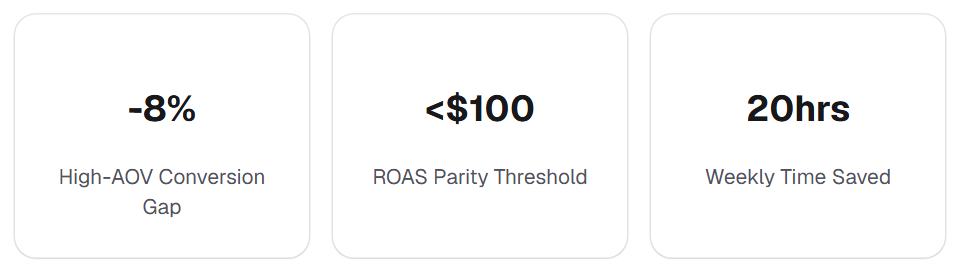
Do not graduate an ad based on three cheap purchases. Wait until the ad has crossed this Digital Applied $100 benchmark spend threshold and maintained a CPA at least 15% below your break-even target. Only then is it a true winner.
Step 3: The Mechanical Transfer
Once validated, the ad must be moved. This is where the execution diverges based on your monthly spend volume. You must choose between a clean, dynamic duplicate or a staged Post-ID transfer.
Spend-Tier Segmentation: How to Execute the Transfer
What works for a massive enterprise account will break a smaller account. Your monthly spend dictates your graduation mechanics.
For Brands Spending $10K–$30K/Month: Clean Duplication
If you are spending under $30,000 a month, your primary constraint is data liquidity. You do not have enough daily budget to support multiple overlapping learning phases. For this tier, Dynamic Duplication is mandatory.
You will duplicate the winning ad directly into your main ASC as a net-new creative. You will lose the existing likes and comments. Accept this. By creating a new ad, you give Meta's Advantage+ system the freedom to generate dynamic formats, swap text overlays, and optimize placements across Reels, Stories, and Feed natively. At this spend level, algorithmic freedom is worth significantly more than social proof.
For Brands Spending $75K–$150K/Month: The Staged ID-Injection
If you are spending over $75,000 a month, you have the budget to support a more complex architecture. You can afford to maintain the social proof without starving the algorithm.
For this tier, do not dump the Post ID directly into your primary ASC. Instead, move the Post ID into a secondary scaling CBO dedicated entirely to proven winners. Because your budget is large enough, this secondary campaign will easily exit the learning phase on its own. You maintain the social proof, and you protect your main ASC from sudden delivery shifts.
Automating the Transfer: A Workflow Teardown
Manual media buying is a liability. You can run creative graduation operations on an automated stack using n8n, Triple Whale, and Claude. In industry operational benchmarks reported by Digital Applied, adopting automated and AI-driven creative workflows saves teams an average of 20 weekly hours in operational time.
Here is the exact mechanical teardown of an automated n8n graduation workflow:
- Node 1: Triple Whale Webhook Trigger. The workflow initiates when Triple Whale detects an ad in the testing campaign has crossed the $100 spend parity threshold and maintained a CPA 20% below target for 72 hours.
- Node 2: The Spend-Tier Router (Switch Node). n8n checks the ad account's 30-day trailing spend. If spend is under $30K, it routes to Path A (Duplication). If over $75K, it routes to Path B (Post-ID).
- Node 3: Claude API (Copy Iteration). For Path A, n8n sends the winning ad's primary text to Claude. Accounting for the Digital Applied benchmark showing an average +12% CTR lift on Meta for optimized creative, the prompt instructs Claude to generate three new text variations based on the winning angle, ensuring the duplicate ad launches with fresh dynamic text options.
- Node 4: Meta Graph API (Execution). n8n pushes the payload to Meta. It either creates a new ad with the Claude variations in the ASC (Path A) or injects the existing Post ID into the secondary scaling CBO (Path B).
- Node 5: Error Handling & Retry Logic. Meta's API frequently rate-limits automated requests. We configure this node with a 3-attempt retry logic using exponential backoff (waiting 1 minute, then 5 minutes, then 15 minutes) before sending a Slack alert to a human operator upon final failure.
What to Skip: The Mistakes Killing Your Scaling
Operators trust systems that tell them what to ignore. When graduating creatives, avoid these common traps:
The Social Proof Obsession
Stop agonizing over losing ten comments and fifty likes. The algorithm optimizes for user behavior and conversion probability, not vanity metrics. As Mate Hunyor's analysis of Meta ads mistakes highlights, clinging to old tactics limits your scale. If a Post ID restricts your ad from appearing natively in Instagram Reels because the aspect ratio is locked, you are losing money.
Pausing the Test Immediately
When you duplicate a winner into your scaling campaign, do not immediately pause the original ad in the testing campaign. The new duplicate will take 24 to 48 hours to gain traction. If you kill the original test ad too early, you create a revenue gap. Let the test ad run until the duplicate in the scaling campaign achieves parity in daily spend, then gracefully pause the test version.
Relying Solely on In-Platform ROAS
Meta's attribution will claim credit for everything it touches. Do not graduate ads based purely on Ads Manager ROAS. Use a third-party tool like Triple Whale or Motion to verify the cost-per-unique-click and new customer acquisition cost before initiating the transfer.
Final Execution
The debate between Post-ID and duplication is solved by your spend tier and your campaign architecture. Stop treating creative testing as a guessing game and start treating it as a mechanical protocol. Separate your environments, validate past the parity threshold, and let the algorithm do the heavy lifting.
Ready to apply this to your brand? Book your free creative audit at dreamfoxverse.com/free-audit/.