
An operator managing over 600 Klaviyo accounts recently published an audit revealing a single default setting was quietly suppressing 20 to 30 percent of total email revenue. The culprit was Smart Sending. Klaviyo enables this feature by default to prevent subscribers from receiving multiple emails within a 16-hour window. In theory, it protects your list from fatigue. In practice, it actively blocks high-intent buyers from receiving the exact transactional emails they triggered.
According to Digital Applied's 2026 playbook, automated flows drive roughly 41 percent of total email revenue from just 5.3 percent of sends. When you throttle that 5.3 percent to protect your broadcast campaigns, you choke the most profitable mechanism in your retention architecture. Aggregated benchmarks, like the 2026 Email Marketing Benchmarks by Industry report, show that performance data is critical, but top-line open rates hide flow-level mechanics. Leaving default platform safeguards active on behavioral automations creates a structural leak where low-intent broadcast campaigns cannibalize high-converting intent messages.
The Math Behind the Revenue Leak
To understand why an estimated 20 to 30 percent revenue lift is possible simply by flipping a toggle, we must examine the mechanical collision between campaign broadcasts and automated flows. Here is a worked calculation of how Smart Sending cannibalizes revenue during a standard promotional week.
- The Baseline: An illustrative DTC brand generates $100,000 a month through email.
- The Scenario: The brand sends a weekly newsletter at 9:00 AM on Tuesday to its entire engaged segment. A customer opens the newsletter, clicks through, adds a $150 item to their cart at 9:15 AM, and abandons checkout.
- The Flow Trigger: The brand's Abandoned Cart flow is correctly configured to trigger 4 hours later, at 1:15 PM.
- The Collision: Because Smart Sending is turned on, Klaviyo checks the 16-hour window. The customer received the newsletter at 9:00 AM, so the 1:15 PM Abandoned Cart email is automatically skipped.
- The Financial Loss: A standard newsletter has an average conversion rate of roughly 0.1 percent. An Abandoned Cart email has an average conversion rate of 4.5 percent. The brand just traded a high-intent conversion opportunity for a low-intent broadcast.
If a brand experiences 500 cart abandonments on a campaign day, and 30 percent are skipped due to the 16-hour rule, that is 150 skipped emails. At a $150 AOV and a 4.5 percent conversion rate, the brand loses $1,012 in direct revenue per campaign day. Over a year of bi-weekly campaigns, that single default setting creates a $105,248 revenue leak.
The Intent-Preservation Flow Framework
To fix this, operators must stop treating all emails equally. A promotional broadcast is a push; an abandoned checkout is a pull. We use the Intent-Preservation Flow Framework to systematically strip Smart Sending from high-intent triggers while keeping it active for low-intent re-engagement.
- Phase One: Core Conversion Overrides. Digital Applied identifies the Welcome, Abandoned Checkout, and Abandoned Cart flows as the foundation of the build order. You must manually open every single email node within these flows. In the settings panel, uncheck the Smart Sending box. If a user takes an action indicating they want to buy, they must receive the follow-up, regardless of what campaigns went out that morning.
- Phase Two: Post-Purchase Isolation. Post-purchase transactional emails, such as order confirmations and shipping updates, should never have Smart Sending enabled. Furthermore, your campaign segments must explicitly exclude users who are currently in the post-purchase flow to prevent messaging collisions.
- Phase Three: Retention Throttling. Smart Sending should remain active on your Sunset and Win-back flows. These users are already disengaged. Hitting them with multiple emails in a 16-hour window will only accelerate spam complaints and damage your sender reputation.
The most expensive mistake in retention marketing is treating a customer's active buying intent as a nuisance that needs to be throttled.
Tailoring the Strategy by Revenue Band
What works for a brand scaling its first major acquisition channel will break a mature brand with a complex retention ecosystem. You must adjust your flow architecture based on your current ad spend and traffic volume.
For Brands Spending $10K to $30K/Month on Paid Ads
At this tier, your primary enemy is obscurity, not list fatigue. You do not have enough traffic to worry about over-emailing your core segments. Your objective is aggressive baseline establishment. Your Meta Advantage+ campaigns are driving top-of-funnel traffic that requires immediate email capture and conversion to be profitable. Turn off Smart Sending across all pre-purchase flows. If you suppress these emails, your blended ROAS drops, and you lose the ability to scale your ad spend. Focus entirely on capturing intent.
For Brands Spending $75K to $150K/Month on Paid Ads
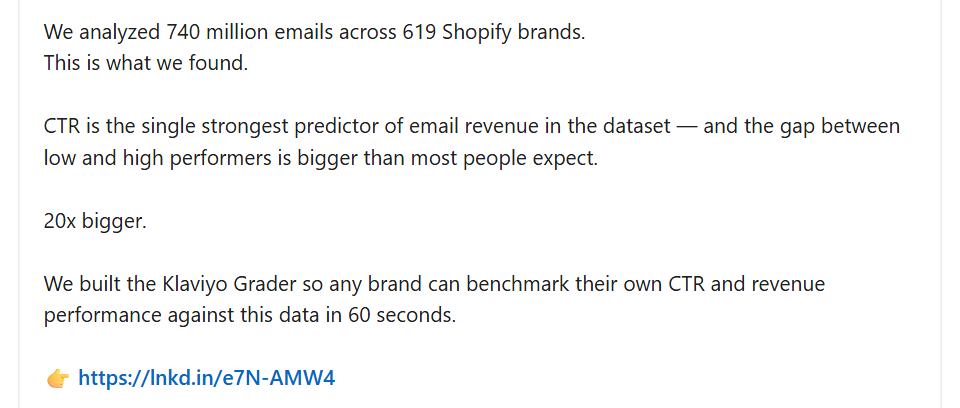
At this scale, you are sending millions of emails a month. According to Larry Kim's analysis of the 2026 Klaviyo Benchmark Report, which evaluated 740 million emails across 600+ brands, list fatigue becomes a measurable drag on deliverability for high-volume senders. Here, you need orchestration. You still turn off Smart Sending for intent flows, but you must implement strict frequency capping on your campaign sends. Brands at this level should use platforms like Triple Whale to monitor cohort LTV, ensuring that aggressive email volume is actually translating to incremental revenue, rather than just pulling forward purchases that would have happened anyway.
What to Skip: The "Set and Forget" Fallacy
Operators often assume that once a flow is built, the job is done. This leads to the most common configuration errors we see in Klaviyo audits. Here is what you must actively avoid:
- Blanket Smart Sending: As highlighted by The Inbox newsletter, leaving Smart Sending turned on is their number one Klaviyo mistake. Never assume out-of-the-box settings are optimized for your specific conversion cycle.
- Ignoring Outdated Flow Versions: As Ben Zettler noted in a recent audit teardown, many brands leave their flows running on old, outdated templates for years. The flow is not technically broken, but the branding, messaging, and product offers are completely disconnected from the current website experience. Audit your creative quarterly.
- Paying for Ghost Towns: A recent Facebook community post highlighted a store paying $375 per month for Klaviyo while running absolutely zero flows or campaigns. If you are paying for an enterprise tool, you must utilize its automation capabilities, starting with the core eight flows.
Automating the Audit Process
Manually checking every email node across hundreds of accounts is impossible. At DFV, we run our own operations on an automated stack using n8n, Claude, and Gemini to monitor flow health without manual intervention.
Our n8n workflow operates on a weekly cron job. It uses HTTP Request nodes to ping the Klaviyo API, pulling the configuration data for every active flow across our managed accounts. The workflow specifically targets the smart_sending_enabled boolean value for each email node. If the Switch node detects that Smart Sending is active on an Abandoned Cart or Checkout flow, it triggers a failure mode.
The JSON payload is then passed to Claude via an API node. Claude parses the response, identifies the specific flow and node ID that violates our Intent-Preservation Framework, and formats a standardized alert. This alert is routed through n8n into a dedicated Slack channel, tagging the responsible strategist. The workflow includes automated retry logic—if the Klaviyo API rate limits the request, an n8n Wait node pauses the execution for 60 seconds before re-initiating the pull. This ensures we never miss a configuration error, maintaining strict compliance with our revenue-maximizing baselines.
Optimizing your retention architecture requires looking past the default toggles and understanding the mechanics of customer intent. By systematically auditing your flows, disabling Smart Sending on high-intent triggers, and aligning your strategy with your spend tier, you reclaim the revenue that lazy configurations leave behind.
Ready to apply this to your brand? Book your free creative audit at dreamfoxverse.com/free-audit/.