
The Cost of Treating Advantage+ Campaigns Like Testing Labs
Dumping untested creative variations directly into an Advantage+ Sales Campaign (ASC) is the fastest way to burn paid media capital. Meta's automated delivery algorithm optimizes for low-hanging conversions based on historic user state, which frequently funnels entire budgets toward existing customers or bottom-funnel retention rather than net-new customer acquisition.
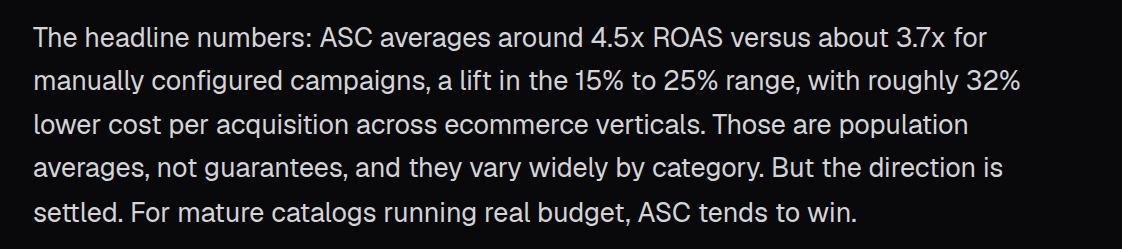
Data tracked by Triple Whale indicates that the ecommerce median CPM rose 13.2% year-over-year to $15.06, while Mako Metrics recorded a 20% jump across all industries to $14.19. While customer acquisition costs absorbed this pressure well—rising only 3.1% due to improvements in creative click-through rates and landing page conversions—media buyers have zero margin for wasteful algorithmic misfires. Skale Strategy notes that while ASC delivers an average 4.5x ROAS versus 3.7x for manual campaigns alongside 32% lower cost per acquisition across ecommerce verticals, feeding ASC unproven creative degrades machine learning efficiencies and spikes blended acquisition costs.
Creative is targeting in modern ad systems. The visual hook, audio track, and opening script dictate who pauses, who clicks, and who converts. When you outsource creative discovery directly to ASC, the algorithm chooses an early winner based on minimal statistical confidence and compounds impressions on a suboptimal asset. To scale sustainably, growth operators need a separate validation quarantine: the Advantage+ Creative Sandbox.
Feeding unvalidated creative variations directly into an Advantage+ Sales Campaign allows algorithmic bias to kill promising hooks before they reach statistical significance.
The Creative Sandbox Protocol (CSP)
The Creative Sandbox Protocol (CSP) isolates variable discovery from machine-driven delivery scaling. By running controlled validation tests in a deterministic environment before promoting winning assets into an ASC scale engine, brands eliminate budget cannibalization and keep conversion data clean.
- Batch Concept Clustering: Group creative concepts into discrete batches of three to five variants testing a single variable (such as three distinct visual hooks attached to one identical problem-solution body). Tools like Foreplay allow creative strategists to curate competitive swipe files and build structured storyboards, ensuring tests address explicit customer pain points rather than arbitrary aesthetic choices.
- Dynamic Sandbox Deployment: Build a dedicated manual Sales campaign using Cost-Per-Click or standard conversion bidding with manual broad targeting (Advantage+ Audience enabled, zero interest or lookalike constraints). Set ad set budgets (ABO) calibrated to reach at least 50 meaningful conversions or 200 outbound clicks per variant. Turn off auto-applied Advantage+ Creative optimizations—such as music overlays or text permutations—to isolate true baseline creative resonance.
- Metric Threshold Gatekeeping: Evaluate assets against platform engagement and downstream efficiency. According to Digital Applied's analysis of 50,000+ ad variations, AI-generated creative frequently outperforms human-made creative on front-end click-through rates but struggles on conversion rates for higher-ticket inventory. Measure cost-per-outbound-click (CPC), outbound CTR, and initial return. Motion's creative analytics dashboards help visualize these retention drop-offs between 3-second hook rates and hold rates.
- Automated Post-ID Extraction: Once an ad variant passes predefined benchmark gates, extract its underlying Facebook Post-ID (social proof preservation). Using automated workflows in tools like n8n or Make, pass the validated Post-ID directly into the primary ASC campaign via Meta's Graph API, bypassing manual duplication errors and retaining accrued likes, shares, and comments.
- Graduation into ASC Core: Inject the validated ad into the scaled Advantage+ Sales Campaign alongside existing baseline controls. Skale Strategy points out that creative diversity fuels ASC stability; injecting pre-vetted hooks provides the machine learning model fresh conversion angles without risking sudden ROAS dips.
Budget Architecture: $10K–$30K/mo vs. $75K–$150K/mo Brands
A testing framework that works for an emerging store will break an enterprise brand. Sandbox architecture must shift based on monthly ad spend to account for sample size and algorithmic volatility.
Tier 1: Emerging DTC ($10K–$30K/Month)
At this spending tier, running multiple isolated test ad sets fragments conversion data too severely. Dedicate 75% to 80% of total ad spend to a single ASC scaling engine. Allocate the remaining 20% to 25% to a single manual ABO campaign containing no more than two test ad sets running concurrently.
For example, a store spending $20,000/month operates on an approximate total daily budget of $666/day. The optimal daily split allocates:
- ASC Scale Engine (80%): $533/day allocated to proven winners.
- Sandbox ABO Testing (20%): $133/day split across two test ad sets ($66.50/day per concept).
Test only extreme variations: completely distinct concepts rather than minor copy iterations. Keep each test active for 5 to 7 days until an asset reaches at least 3x the target CPA in spend. If it does not generate profitable conversions, pause it immediately. Do not graduate more than one asset every two weeks into the primary ASC.
Tier 2: Scaling DTC ($75K–$150K/Month)
Larger spend tiers require high-frequency testing pipelines to combat creative fatigue. Allocate 85% of spend to the scaling ASC and 15% to sandbox validation. This 15% budget provides sufficient volume to run continuous dynamic creative testing (DCT) environments testing 10 to 15 new concepts per week.
For instance, a store spending $100,000/month operates on an approximate total daily budget of $3,333/day. The daily capital allocation breaks down as:
- ASC Scale Engine (85%): $2,833/day sustaining core automated scale.
- Sandbox ABO Testing (15%): $500/day distributed across five isolated test ad sets ($100/day each).
Brands at this level must track blended multi-touch metrics using tools like Triple Whale or Klaviyo zero-party data to verify that new creative concepts acquire truly incremental customers rather than cannibalizing existing brand search or email flows. Run tests in dedicated sandboxes with Advantage+ Placements on, graduating top performers using automated n8n webhooks when return targets hold across a rolling 72-hour window.
What to Skip: Common Testing Traps
Building an effective creative testing pipeline requires knowing what metrics and tactics to discard. Media buyers often waste hours fine-tuning parameters that the algorithm systematically ignores.
- Skip Micro-Audience Splitting: Do not run sandbox tests against hyper-segmented interest groups or stacked 1% lookalikes. Meta's modern auction uses the creative itself to find the target audience. Testing creative inside restricted audiences produces false positives that collapse when graduated to broad ASC delivery.
- Skip Daily Budget Tweaks: Avoid making daily modifications to sandbox budgets. Research on Advantage+ campaigns emphasizes avoiding unnecessary daily adjustments. Changing budgets resets algorithmic learning phases and skews distribution metrics.
- Skip Evaluating Creatives on Blended ROAS Alone: Never promote an ad simply because it shows a high in-platform ROAS on low spend. An ad with $40 in spend and one $200 purchase is a statistical anomaly, not an ASC-ready winner. Demand minimum statistical volume before graduation.
- Skip Meta's Automated Creative Enhancements in Sandboxes: When deploying initial creative tests, turn off Meta's automated 3D effects, automated image expansions, and AI music additions. If the raw concept cannot convert on its own core message, automated cosmetic overlays will not fix the underlying deficit.
The Production Sandbox Decision Protocol
Use this structured decision matrix to evaluate upstream hook and hold telemetry alongside statistical confidence thresholds before promoting an asset into the primary Advantage+ Sales Campaign:
| Stage Gate | Evaluation Metric | Pass Criteria | Fail Action | ASC Promotion Action |
|---|---|---|---|---|
| Stage 1: Hook Viability | Hook Rate (3-sec views / impressions) | ≥ 25% Hook Rate | Pause and rework visual hook in the first 3 seconds | Hold in Sandbox |
| Stage 2: Click Telemetry | Outbound CTR & CPUC | Outbound CTR > 1.2% and CPUC ≤ account 30-day median | Archive asset if CPUC > 30% above median after $100 spend | Hold in Sandbox |
| Stage 3: Statistical Conversion | Conversion Volume & CPA | 25–50 purchase events at or below target CPA | Kill ad set if CPA > 1.5x target after spending 3x target CPA | Stage Post-ID for graduation |
| Stage 4: Post-ID Promotion | 72-Hour ROAS Stability | ROAS variance ≤ 15% across a rolling 72-hour window | Retain in Sandbox for secondary 48-hour observation | Inject Post-ID into primary ASC; run sandbox at low spend for 48 hours |
By enforcing this systematic pipeline, you preserve the high-efficiency benefits of Advantage+ Shopping Campaigns while systematically protecting your ad spend from premature algorithmic burnout.
Ready to apply this to your brand? Book your free creative audit at dreamfoxverse.com/free-audit/.